   |
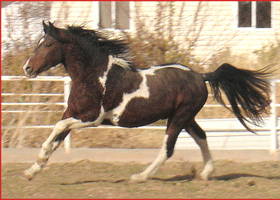
Décomposition des allures GAITED The CURLY Missouri Fox Trotter
Genetic research is in sight! |
. |


To understand why some horses are gaited... Niina recently decided to include researches about our wonderful gaited Curlies, pedigrees including Walkers Prince T, Sir Patrick MJT, Star�s Lucky Touch or from the Foxtrotters origins. All of the gaited Curlies at JAK stud are making a part of this research. It�s encouraged by the ICHO, several samples of French hairs were sent to Sweden. Stay tuned ! A test already exists!!
|
A trait that seem to be lost in Europe, where the Amble pace is considered a blemish!!
It�s a walking pace and smooth, both fast and comfortable for the rider... et |
How they came to the United States is a mystery.
They have been documented among wild horse populations of the North American West since the 1700s, and Indian pictographs show that the Sioux and the Crow Indians had curly coated horses in the early 1800s There is evidence of Curly horses in many places around the world at different times. Charles Darwin wrote of curly haired horses in South America. Curly horses are depicted in Chinese artwork dating back to 161 A.D. Whether all of these Curlies are related is unknown. Though the North American Curly horse is not considered a true breed - by scientific guidelines they are considered a coat type - the goal of many Curly breeders is to develop real breeds of horses that are curly coated. Since the 1930s, Curlies have been crossbred to Fox Trotters, Peruvians, Walking Horses, Standardbreds, Paso Finos, Morgans, Arabs, Quarter Horses, Warmbloods and many other breeds, including miniatures and drafts. Breeders are also just as dedicated to preserving the old bloodlines that still exist, but with limited genetics, crossbreeding has been necessary to prevent inbred genetic problems. Gaited Curly horses developed by crossbreeding Curly haired horses to gaited horses, most commonly Missouri Fox Trotters, Tennessee Walking Horses, Paso Finos, Peruvians, and other strongly naturally gaited breeds. Since the American Curly horse carries the blood of many types of horses, from mustangs to Morgans, it is no surprise that many have a "shuffle", running walk, or "amble" of some sort. About 10% of American Curlies will do a fox trot or running walk, making them ideal to crossbreed with gaited horses for increased gait. Characteristics of Gaited Curly horses include soft, fine body hair that is longer and curlier in the winter than in the summer. Depending on the degree of Curliness, horses may shed some hair or none at all. Their manes often have ringlets or tendrils, and split down the middle, parting to both sides. Coat textures among Curlies vary, from the tight curls of a micro pin Curly, to the crushed velvet types, to the gentle wavy coats of some minimally expressed Curlies. Extreme Curlies shed out most of their mane and tail hairs, and sometimes even the body coat. These extreme Curlies are sometimes referred to as "rat tails" or "baldies". Average height is about 14.1 to 15.1 hands - though Curly horses come in a variety of shapes, sizes and colors. Appaloosa and pinto markings, as well as solid colors, are common. Structure is similar to that of the early Morgan horses; they are sturdy and strong with excellent stamina, rounded conformation and a heart of gold! Curlies have strong, rounded hooves that are often black, even horses with all white socks often have black hooves. Some horses have a sleepy look to their eyes, as they have a slightly almond shape, which may actually improve range of vision, but Curly owners say that the sleepy look is deceiving. Their horses have proud carriage, are very alert and not a bit lazy! Curlies are born with an outgoing and friendly personality that grows into a responsive, intelligent and easily trainable disposition. They are suitable for almost any discipline, Western, English, pleasure or endurance trials.
|